 bootsgrid
The right ecommerce platform can support growth for years, while the wrong choice can create limitations, unexpected costs, and operational challenges. Heres what businesses should consider before making a decision.
Choosing an ecommerce platform is one of the most important decisions a business can make. The platform you select affects everything from customer experience and website performance to operational efficiency, marketing capabilities, and future scalability.
Many businesses approach platform selection by comparing features or pricing alone. While those factors matter, they rarely tell the full story.
A platform that works perfectly for a startup may become restrictive for a growing retailer. Likewise, a powerful enterprise platform may introduce unnecessary complexity for a smaller business.
The challenge is not finding the most popular platform. The challenge is finding the platform that aligns with your business goals, growth plans, technical requirements, and customer expectations.
As ecommerce continues to evolve in 2026, businesses must look beyond basic feature comparisons and evaluate platforms through a long term lens.
Why Platform Selection Matters More Than Ever
Consumer expectations continue to rise.
Customers expect:
- Fast loading websites
- Mobile friendly experiences
- Seamless checkout processes
- Personalized shopping journeys
- Reliable performance during peak traffic
- Secure payment experiences
Your ecommerce platform serves as the foundation supporting all of these expectations.
Changing platforms later can be costly and time consuming. Product data, customer information, SEO performance, integrations, and custom functionality may all require migration.
Making the right decision from the beginning helps avoid unnecessary disruptions as your business grows.
Common Mistakes Businesses Make When Choosing a Platform
Before exploring specific platforms, its important to understand some of the mistakes businesses frequently make.
Choosing Based Solely on Cost
Lower monthly fees can appear attractive initially, but businesses often discover additional expenses related to apps, integrations, customizations, and scalability.
The cheapest option is not always the most cost effective solution in the long run.
Ignoring Future Growth
Many businesses choose a platform based on current requirements without considering future expansion.
Questions worth asking include:
- How many products will we manage in three years?
- Will we expand internationally?
- Do we need multiple storefronts?
- Will we require custom checkout experiences?
- Are advanced integrations likely in the future?
Growth can quickly expose platform limitations.
Overlooking Operational Requirements
Platform decisions should involve more than marketing teams.
Operations, customer service, inventory management, finance, and IT requirements should also be considered.
A platform must support the entire business, not just the website.
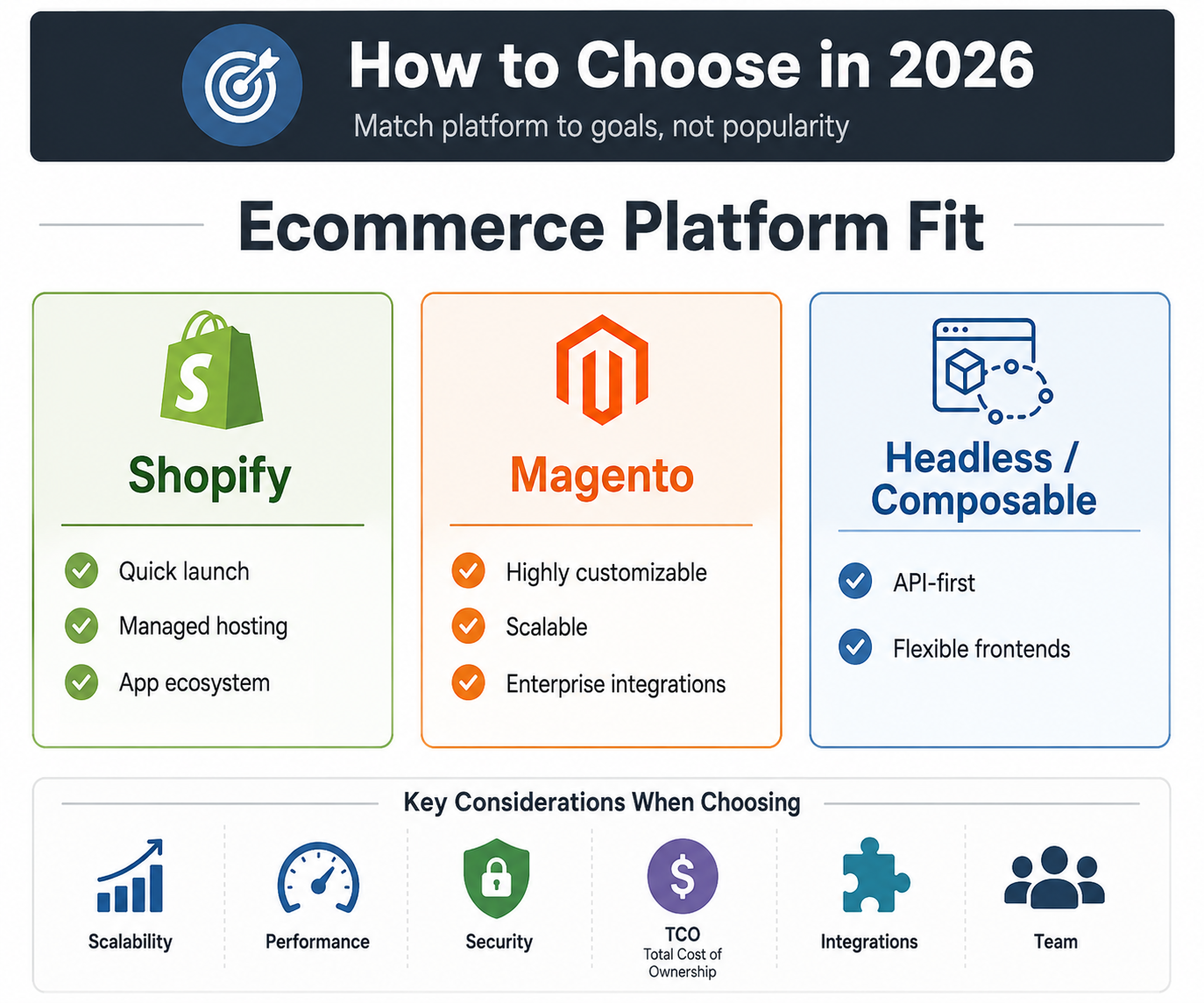
Key Factors to Evaluate
Scalability
Can the platform handle increasing traffic, products, orders, and customer accounts?
Businesses planning aggressive growth should prioritize scalability from the beginning.
Flexibility
Every business eventually develops unique requirements.
Evaluate:
- Custom development capabilities
- API availability
- Third party integrations
- Workflow customization
Flexibility becomes increasingly important as businesses mature.
Performance
Website speed directly impacts customer experience and conversions.
Consider:
- Page load speed
- Hosting infrastructure
- Caching capabilities
- Performance optimization options
Security
Customers trust businesses with sensitive information.
The platform should support:
- Secure payment processing
- Data protection
- Compliance requirements
- Regular security updates
Total Cost of Ownership
Look beyond monthly subscription costs.
Consider:
- Development expenses
- Hosting costs
- Extensions and applications
- Maintenance requirements
- Support costs
A complete financial picture provides a more accurate comparison.
When Shopify Makes Sense
Shopify continues to be one of the most popular ecommerce platforms because it simplifies many aspects of online selling.
It is particularly attractive for businesses that want to launch quickly and focus on operations rather than technical management.
Shopify often works well for:
- Startups
- Small to medium sized businesses
- Direct to consumer brands
- Businesses seeking faster implementation
Key advantages include:
- User friendly administration
- Reliable hosting
- Strong ecosystem of applications
- Simplified maintenance
- Built in security management
However, businesses should also consider future customization requirements. As operational complexity grows, some businesses may encounter limitations that require additional development or platform upgrades.
When Magento Makes Sense
Magento remains one of the most powerful ecommerce platforms available for businesses requiring extensive flexibility and customization.
It is often selected by organizations with complex requirements and long term growth objectives.
Magento can be particularly effective for:
- Large product catalogs
- Multi store operations
- International commerce
- Complex pricing structures
- Advanced integrations
- Custom business workflows
Key advantages include:
- Extensive customization capabilities
- Strong scalability
- Enterprise level flexibility
- Advanced catalog management
- Powerful integration options
Magento generally requires greater technical expertise than Shopify, but it offers significantly more control over how the ecommerce experience is designed and managed.
For businesses that require highly customized ecommerce solutions, this is an ideal location to reference your Magento development services page.
Magento vs Shopify: Which Is Better?
This is one of the most common questions businesses ask.
The reality is that neither platform is universally better.
The better platform depends on business requirements.
Shopify may be the better choice when:
- Speed of launch is important
- Simplicity is preferred
- Technical resources are limited
- Standard ecommerce functionality meets requirements
Magento may be the better choice when:
- Customization is critical
- Complex integrations are required
- Large scale operations are involved
- Unique customer experiences must be created
The decision should be based on business objectives rather than platform popularity.
Questions Every Business Should Ask Before Choosing
Before making a final decision, consider the following questions:
What are our growth goals?
The platform should support future growth rather than simply current needs.
How much customization will we need?
Businesses with unique requirements should carefully evaluate platform flexibility.
What internal technical resources do we have?
Some platforms require greater technical involvement than others.
What systems must integrate with the platform?
Examples include:
- ERP systems
- CRM platforms
- Retail finance providers
- Payment gateways
- Inventory management systems
What customer experience are we trying to create?
The platform should support the customer journey you envision.
Migration Considerations
Businesses considering a platform change should plan carefully.
Common migration challenges include:
- Product data migration
- Customer account migration
- SEO preservation
- URL restructuring
- Integration updates
- Order history transfers
A well planned migration minimizes disruption and protects business continuity.
This section is a natural location to link your ecommerce migration services page.
Final Thoughts
There is no universal answer to the ecommerce platform question.
The right platform depends on your business goals, technical requirements, operational complexity, and growth strategy.
For businesses seeking simplicity, speed, and ease of management, Shopify can be an excellent solution.
For organizations requiring advanced customization, complex integrations, and long term flexibility, Magento remains one of the strongest platforms available.
The most successful businesses are not necessarily those using the most popular platform. They are the businesses that choose a platform aligned with their unique requirements and future vision.
Taking the time to evaluate your needs carefully today can help avoid costly migrations, technical limitations, and growth challenges tomorrow.
Frequently Asked Questions
Which ecommerce platform is best for small businesses?
Shopify is often a strong choice for small businesses due to its simplicity, hosting, and ease of management.
Which platform offers greater customization?
Magento generally provides more customization flexibility than Shopify.
Can businesses migrate from Shopify to Magento later?
Yes. Many businesses begin with Shopify and later migrate as operational requirements become more complex.
Is Magento only suitable for large businesses?
No. Magento can support businesses of various sizes, although its flexibility is often most valuable when advanced requirements exist.
How important is scalability when choosing a platform?
Scalability is one of the most important factors because changing platforms later can involve significant effort and cost.
Should businesses choose based on price alone?
No. Long term scalability, functionality, support, and operational requirements should all be considered alongside pricing.