 bootsgrid
Most ecommerce businesses understand the value of maintenance in everyday operations.
They regularly service vehicles, maintain office equipment, update software, and monitor financial performance. However, when it comes to ecommerce websites, maintenance is often viewed as something that can be postponed until a problem appears.
Unfortunately, that approach can become expensive.
Many Magento store owners only start thinking about maintenance after they encounter slow website performance, checkout failures, security concerns, broken functionality, or unexpected downtime. By that point, the discussion is no longer about maintenance it is about repairs.
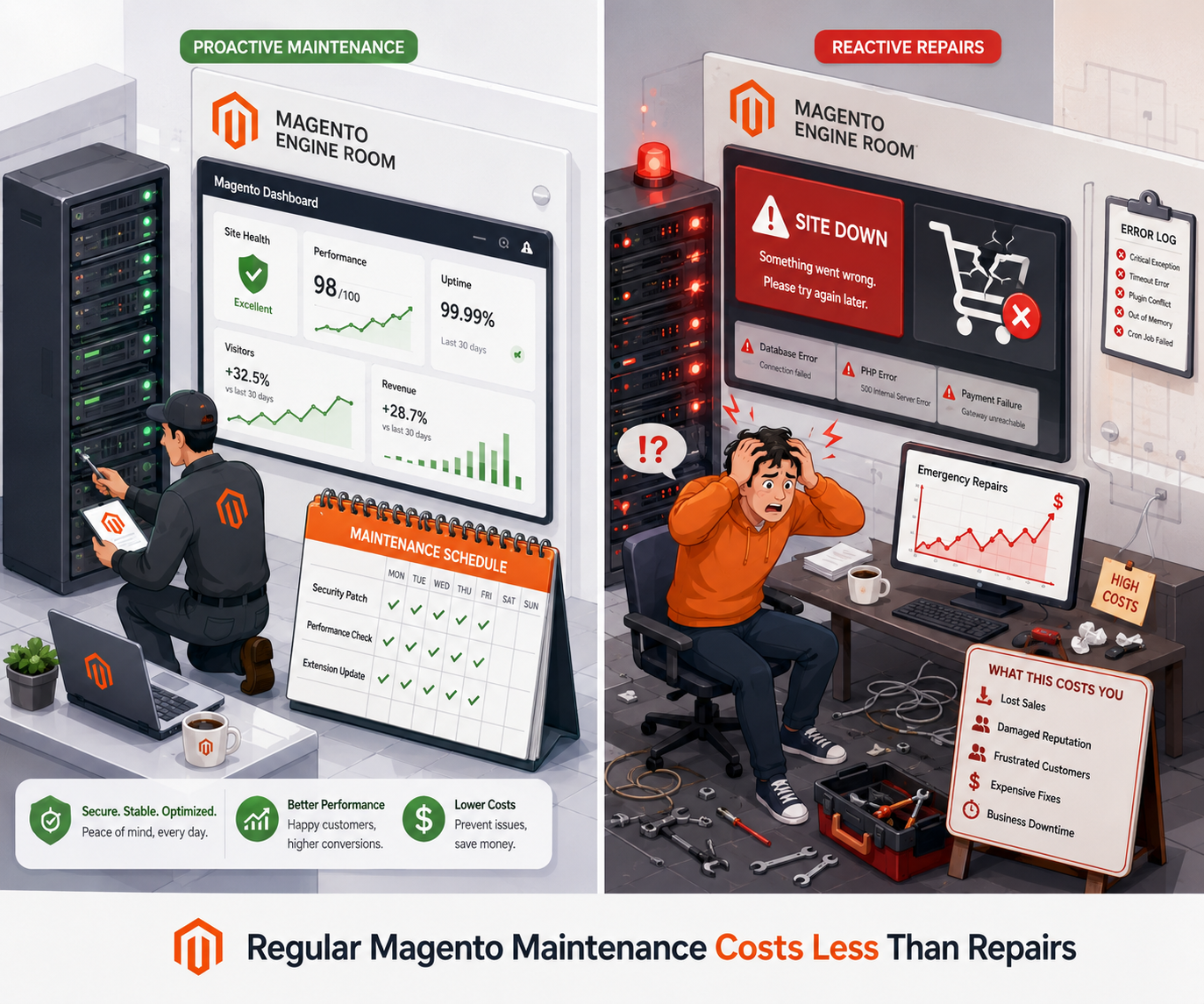
The difference between maintenance and repairs is similar to the difference between regular health checkups and emergency treatment. One is proactive and controlled, while the other is reactive and often significantly more expensive.
For Magento merchants, understanding this difference can help protect revenue, improve customer experience, and support long term business growth.
Understanding the Difference Between Maintenance and Repairs
Magento maintenance focuses on preventing issues before they affect the business.
Typical maintenance activities include:
- Security updates
- Performance monitoring
- Database optimization
- Extension reviews
- Error log monitoring
- Compatibility testing
- Routine health checks
Magento repairs happen after a problem has already impacted the website.
Examples include:
- Website outages
- Broken checkout functionality
- Security breaches
- Failed upgrades
- Extension conflicts
- Integration failures
- Performance emergencies
The key distinction is simple.
Maintenance reduces risk. Repairs address damage after it has occurred.
Small Problems Rarely Stay Small
Many merchants assume minor technical issues can safely wait.
A warning in the admin panel, an occasional error message, or a slightly slower page may not seem urgent.
However, most major Magento problems begin as small issues that were ignored.
Examples include:
- Slow category pages
- Cron job failures
- Indexing problems
- Outdated extensions
- Cache inconsistencies
- API integration errors
Over time, these seemingly minor issues can affect customer experience, operational efficiency, and revenue.
Businesses that address technical concerns early typically spend less money than those that wait until systems begin failing.
Downtime Is More Expensive Than Most Businesses Expect
When a Magento store becomes unavailable, the impact extends far beyond technology.
Customers cannot browse products.
Orders cannot be placed.
Marketing campaigns continue sending traffic to a website that may not function properly.
Customer support teams often experience increased workloads while trying to respond to complaints.
Downtime can result in:
- Lost sales
- Reduced customer trust
- Damaged brand reputation
- Increased support costs
- Missed marketing opportunities
A few hours of unexpected downtime can often cost more than months of proactive maintenance.
Security Risks Continue to Grow
Cybersecurity remains one of the strongest reasons to maintain a Magento store properly.
Modern ecommerce websites manage sensitive information including:
- Customer data
- Order information
- Payment related records
- Business critical data
Outdated software, unsupported modules, and delayed security patches can create vulnerabilities that attackers may exploit.
The consequences can be severe:
- Data breaches
- Revenue loss
- Customer distrust
- Regulatory concerns
- Expensive recovery efforts
Routine maintenance significantly reduces these risks by ensuring updates and security patches are applied promptly.
Delayed Updates Often Lead to Bigger Problems
One of the most common reasons businesses postpone maintenance is that everything appears to be working.
Unfortunately, software ecosystems continue evolving even when stores appear stable.
Magento releases updates.
Extensions receive new versions.
Third party integrations change.
Hosting environments evolve.
As time passes, compatibility gaps can begin to appear.
Eventually, businesses may discover that multiple updates must be completed simultaneously, creating a more complicated and expensive project.
Regular maintenance helps keep systems aligned and prevents large upgrade challenges from developing.
Performance Problems Can Directly Affect Revenue
Customers expect fast ecommerce experiences.
Research consistently shows that users are less likely to complete purchases when websites become slow or unresponsive.
Performance issues often develop gradually due to:
- Growing product catalogs
- Increasing database size
- Additional integrations
- Poorly optimized extensions
- Infrastructure limitations
Common symptoms include:
- Slow page loading
- Delayed product searches
- Checkout lag
- Poor mobile performance
These issues can negatively affect conversion rates and customer satisfaction.
Regular maintenance helps identify performance bottlenecks before they begin impacting sales.
Technical Debt Becomes More Expensive Over Time
Technical debt refers to the accumulation of outdated code, unsupported functionality, and temporary solutions that remain in place for too long.
Technical debt often develops through:
- Quick fixes
- Delayed updates
- Legacy customizations
- Unsupported modules
- Incomplete documentation
At first, technical debt may seem manageable.
Over time, however, it increases development complexity and makes future changes more expensive.
Tasks that should take hours may eventually require days because developers must navigate outdated code and dependencies.
Proactive maintenance helps prevent technical debt from reaching costly levels.
Emergency Repairs Usually Cost More
Emergency situations often require immediate action.
When a checkout stops working or a website becomes unavailable, businesses need urgent support.
Emergency repair projects often involve:
- Rapid diagnostics
- Priority scheduling
- Immediate troubleshooting
- Temporary workarounds
- Unplanned development hours
The urgency alone often increases costs.
By comparison, maintenance activities can be scheduled strategically and completed under controlled conditions.
What Effective Magento Maintenance Includes
A successful maintenance strategy involves much more than installing updates.
It requires continuous monitoring and proactive improvements.
Key maintenance activities include:
Security Monitoring
Regular reviews of vulnerabilities, patch releases, and security best practices.
Performance Monitoring
Tracking website speed, server resources, and customer experience metrics.
Database Optimization
Maintaining database efficiency and preventing performance degradation.
Extension Management
Reviewing extension compatibility, updates, and functionality.
Error Log Analysis
Identifying hidden issues before customers experience them.
Compatibility Testing
Ensuring Magento, extensions, integrations, and hosting environments continue working together properly.
Many businesses rely on a dedicated Magento Maintenance Service to manage these activities consistently and reduce operational risk.
Signs Your Magento Store Needs Maintenance
Many stores display warning signs long before major issues occur.
Common indicators include:
- Increasing page load times
- Frequent admin errors
- Delayed upgrades
- Extension conflicts
- Checkout issues
- Unexpected downtime
- Rising development costs
- Customer complaints about performance
Ignoring these signals often leads to larger and more expensive problems later.
Why Maintenance Supports Long Term Growth
As ecommerce businesses grow, their technical environments become more complex.
Growth often introduces:
- Larger product catalogs
- More customer traffic
- Additional integrations
- Expanded marketing tools
- New operational requirements
Without regular maintenance, this complexity can gradually affect website performance and stability.
Businesses that invest in a professional Magento Maintenance Service are often better positioned to identify issues early, maintain platform health, and support long term scalability.
Rather than constantly reacting to problems, they can focus on growth initiatives and customer experience improvements.
The Financial Case for Preventive Maintenance
Many merchants evaluate maintenance solely as an expense.
However, the better question is:
What does it cost if maintenance is ignored?
Potential consequences include:
- Emergency development projects
- Revenue loss from downtime
- Security incident recovery
- Customer trust issues
- Upgrade complications
- Reduced conversion rates
When viewed from this perspective, maintenance becomes an investment in business continuity and long term profitability.
Final Thoughts
Magento is a powerful platform capable of supporting complex ecommerce operations and long term business growth. However, like any business critical system, it requires ongoing attention to remain secure, stable, and efficient.
Many merchants view maintenance as an optional expense, but the reality is that proactive maintenance often costs significantly less than reacting to unexpected failures, downtime, security incidents, or performance issues.
The most successful Magento businesses understand that preventing problems is usually easier, faster, and more affordable than fixing them after they occur.
Working with a reliable Magento Maintenance Service provider can help businesses stay ahead of technical challenges, improve website performance, reduce operational risks, and create a stronger foundation for future growth.
In the long run, maintenance is not simply about keeping a website running—it is about protecting revenue, supporting customer experience, and ensuring the platform can continue growing alongside the business.
Frequently Asked Questions
Why is Magento maintenance important?
Magento maintenance helps prevent security vulnerabilities, performance issues, compatibility conflicts, and unexpected downtime before they impact customers and business operations.
How often should Magento maintenance be performed?
Magento stores benefit from continuous monitoring and regular maintenance throughout the year, especially after updates, new integrations, or significant business changes.
What is the difference between Magento maintenance and repairs?
Maintenance is proactive and focuses on prevention. Repairs are reactive and occur after issues have already affected the website.
Can Magento maintenance improve website performance?
Yes. Regular maintenance can identify bottlenecks, optimize resources, improve loading speeds, and enhance overall customer experience.
Does Magento maintenance help with security?
Absolutely. Security patches, vulnerability reviews, and extension updates are critical components of effective Magento maintenance.
Is Magento maintenance cheaper than emergency repairs?
In most cases, yes. Preventive maintenance typically costs far less than resolving major outages, security incidents, or critical performance issues.
What happens if Magento maintenance is ignored?
Ignoring maintenance can lead to performance degradation, security vulnerabilities, extension conflicts, costly upgrades, and unexpected downtime